Massage Equipment Market Statistics: Device Trends & Industry Growth

Last updated: March 2026 • Scope: United States
Massage devices have moved from “nice to have” wellness gadgets to everyday tools many Americans use for relaxation, workout recovery, and managing common aches and tension. The broader massage equipment market includes massage chairs, handheld and percussion massagers, foot massagers, neck massagers, and other consumer wellness devices.
In the United States, the massage device market has expanded steadily as more people build at home self care routines and look for convenient, non invasive options alongside professional care.
This page compiles the most reliable massage equipment market statistics available for the U.S., combining national health survey data with market research estimates to illustrate how the U.S. massage equipment market is growing. Charts and tables highlight key trends across consumer adoption, product categories, and long term industry growth.
Table of contents
Key massage device statistics in the U.S.
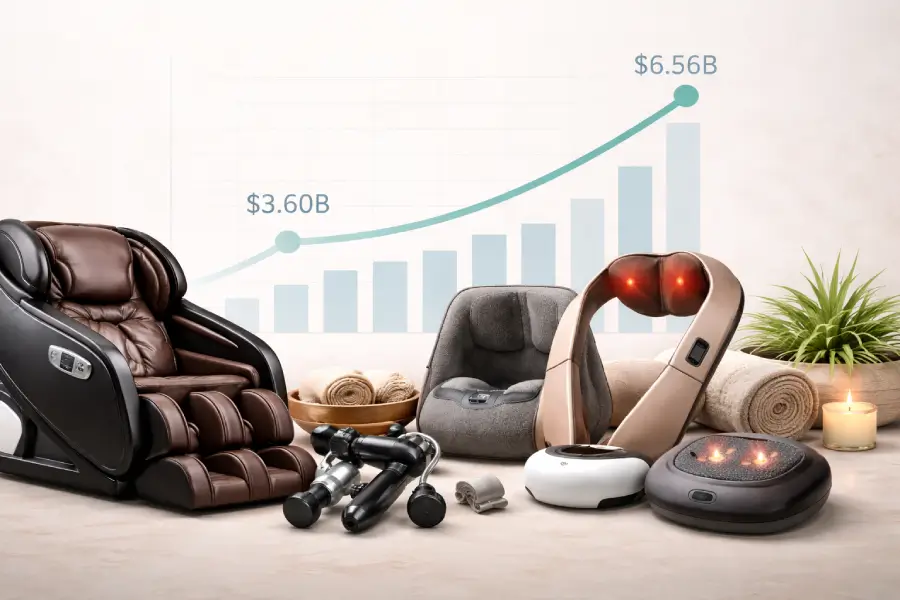
- Massage equipment market: approximately $3.60B in U.S. revenue in 2024, with projections reaching about $6.56B by 2033 based on industry outlooks.
- Massage use among adults: the share of U.S. adults reporting massage use increased from 4.8% in 2002 to 10.9% in 2022, more than doubling over 20 years.
- At-home dominance: consumer home use products account for an estimated 65–70% of U.S. massage equipment sales, outpacing commercial purchases such as gyms and wellness centers.
- Massage chairs as top revenue segment: chairs typically represent the largest share of category revenue, driven by higher average prices and longer product lifecycles compared to handheld devices.
- Handheld device adoption: handheld and percussion massagers are among the fastest growing segments, with projected growth rates in the 6–8% annual range through the early 2030s.
Market size & growth
The United States is widely considered the largest single-country market for massage devices. The U.S. massage equipment market includes massage chairs, handheld percussion devices, and other consumer massage products designed for home wellness and recovery.
Growth in the massage device market is supported by both consumer demand for home wellness and recovery routines and commercial demand from gyms, wellness centers, and healthcare adjacent settings.
Massage equipment market: revenue outlook
Revenue in USD billions. Endpoints are from a U.S. market outlook.
| Year | Revenue (USD) |
|---|---|
| 2024 | $3.5988B |
| 2033 | $6.5576B |
In practice, this growth tracks a broader shift: massage devices are increasingly treated as long term wellness purchases rather than occasional splurges. Product variety is also expanding, with more compact designs and lower cost options bringing massage devices into a wider range of households.
Usage & adoption trends
Device-specific usage surveys are limited in the public domain, but national health survey trend reporting provides a strong signal: reported massage use among U.S. adults has risen substantially over the last two decades. This matters because growing acceptance of massage as a wellness practice tends to increase interest in at-home devices.
Reported massage use in the U.S.: 2002 vs. 2022
Share of adults reporting massage use based on survey trend reporting.
| Year | Adults reporting massage use |
|---|---|
| 2002 | 4.8% |
| 2022 | 10.9% |
In day-to-day life, adoption often shows up in short routines: evening relaxation sessions, targeted post-workout recovery, and “desk day” relief focused on the neck, shoulders, and lower back.
Massage chairs vs. handheld/percussion devices
Massage chairs
Massage chairs are typically the largest revenue segment because they deliver full-body sessions and sit at higher price points. Many buyers choose chairs for long-term comfort and a spa-like experience at home. The category has broadened in recent years: premium models still drive revenue, but more compact and mid-range designs make ownership more realistic for smaller homes.
Handheld and percussion devices
Handheld and percussion-style devices tend to grow quickly because they’re portable, relatively affordable, and easy to use in short, targeted sessions. They’re popular for workout recovery, but many users also reach for them to manage everyday tension. As the category matures, comfort, ergonomics, noise levels, and safe usage patterns tend to matter more than raw power alone.
Other massage devices: foot, back & neck massagers
Beyond chairs and handheld percussion tools, a large portion of the category is made up of simpler devices designed for specific areas of the body. Foot massagers, neck and shoulder massagers, and back and seat cushions tend to appeal to buyers who want targeted relief without a large purchase or a bulky footprint.
These products are often used in shorter sessions and tend to emphasize convenience: easy storage, quick setup, and one-button routines. For many households, they serve as entry-level devices that can later lead to upgrades, for example from a neck massager to a massage gun, or from a seat cushion to a compact chair.
Because these devices are typically lower cost, growth in this group is driven more by unit sales and seasonal demand than by premium pricing. They also show up frequently as gifts, which can create noticeable spikes around holidays and shopping events.
Who uses massage devices in the U.S.?
Massage devices are used by a wide range of consumers, but a few groups tend to appear repeatedly in both wellness research and market analysis. The needs differ by lifestyle, which is one reason the category includes everything from high-end chairs to inexpensive targeted massagers.
Common massage device users
- Athletes and active consumers: often use handheld or percussion devices as part of warm-up and recovery routines.
- Office and remote workers: frequently prioritize neck, shoulder, and lower back relief after long sitting periods.
- Older adults: may look for comfort-focused devices and gentle routines that support relaxation and mobility habits.
- General wellness buyers: typically use devices for stress relief, evening relaxation, and sleep-adjacent wind-down routines.
Because needs vary so widely, the most popular products often focus on ease of use: quick presets, gentle ramp-up options, and clear safety guidance around session length and frequency.
Reported benefits & consumer behavior
Across categories, consumers most often describe using massage devices for stress reduction, muscle recovery, and everyday pain management. This aligns with broader health context: musculoskeletal discomfort is common, and many people look for non-invasive ways to manage routine aches and tension.
In many households, massage devices are used as wellness tools rather than medical treatments. Usage often becomes habitual: a few short sessions per week after workouts, after long desk days, or as part of a relaxing evening routine.
Key trends driving demand
Several trends are currently shaping the massage equipment market. Industry analysts frequently highlight the growth of at-home wellness products, portable massage devices, and ergonomic recovery tools.
Key massage device trends include the increasing popularity of percussion massage guns, compact massage chairs designed for smaller homes, and affordable targeted massagers for the neck, feet, and lower back.
Through the remainder of the decade, growth is likely to be strongest in products that balance comfort, safety, and value, and in designs that fit smaller spaces while still delivering meaningful relaxation and recovery benefits.
Sources & methodology
Sources are consolidated here to keep outbound links limited. Market estimates can vary by scope, including included products, consumer vs. commercial sales, and forecasting methods. Figures reflect the most recent publicly available U.S.-focused estimates and survey trend reporting as of 2024–2025.
- Massage use trend among U.S. adults: NCCIH – Massage therapy overview & national survey trend summary
- U.S. market endpoints for total massage equipment: Grand View Research – U.S. massage equipment outlook
- Complementary approaches and pain context: NCCIH – Complementary approaches for pain from 2002 to 2022
- Broader U.S. health context: CDC – Arthritis basics and musculoskeletal burden context
Readers looking for practical, category specific guidance may also find these in depth resources helpful:
5 Best Motion Sensor Lights for Outside 2026 – Bright & Reliable
How to Use a Massage Chair: Tips, Timing & Common Mistakes